
Data Pauses as Government Funding Lapses
EBRC Research Staff
Current data releases as of 9 April 2025
Due to the lapse in federal funding, several key government data releases are currently suspended. This includes the U.S. Employment Situation and U.S. International Trade update, which will not be updated until appropriations are restored. The Economic and Business Research Center will continue to monitor and report on available data releases during this period. The EBRC will provide updates on the resumption of federal data publications as information becomes available.
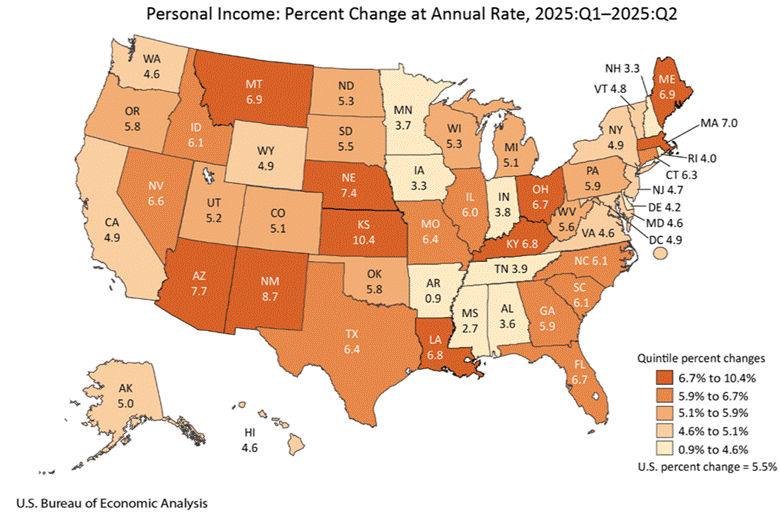
Arizona personal income rose rapidly in the second quarter of 2024, increasing by 7.7% at a seasonally adjusted annual rate. That far exceeded the national pace of 5.5% and ranked the state third in the nation. Kansas posted the fastest increase in the second quarter at 10.4% while Arkansas posted the slowest at 0.9%. Personal transfer receipts (Social Security, Medicare, Medicaid, and other transfers) rose the fastest among the major components for most states and the nation. Transfer payments rose 21.6% in the second quarter for Arizona (ranking the state third in the nation). Nationally, transfer payments rose 14.4%. Net earnings from work rose 5.4% in Arizona in the second quarter, ranking the state ninth in the nation and outpacing the U.S. at 4.4%. Finally, income from dividends, interest, and rent rose 1.2% over the quarter, ranking Arizona fourth in the nation, and again beating the national average of 1.0%. -George Hammond
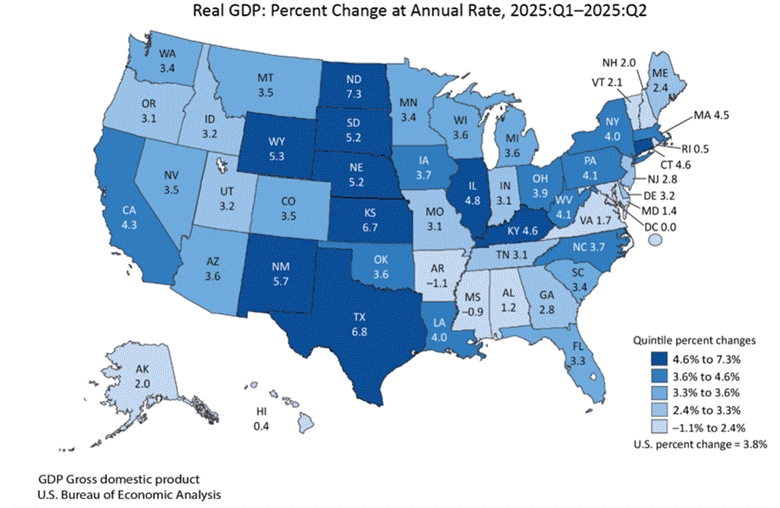
Arizona real GDP rose 3.6% over the quarter in the second quarter of 2025 (seasonally adjusted annual rate), slower than the national pace of 3.8%. That ranked Arizona 23rd in the nation. North Dakota ranked first with a 7.3% increase, while Arkansas ranked last with a 1.1% decrease. Over the year, Arizona real GDP rose by 2.1%, matching the national rate. That ranked Arizona 15th in the nation. Across industries, management of companies generated the fastest increase in real GDP, with a 13.7% increase. That was followed by professional, scientific, and technical services (up 8.1%); finance and insurance (up 6.3%); and health care and social insurance (up 4.9%). Those gains were partly offset by declines in agriculture, forestry, fishing, and hunting (down 8.7%); arts, entertainment, and recreation (down 2.9%); administrative and support services (down 2.1%); and manufacturing (down 1.8%). Within manufacturing, both durables and nondurables were down over the year. -George Hammond
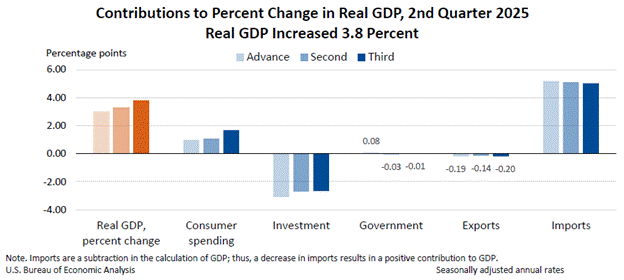
Real gross domestic product (GDP) increased at an annual rate of 3.8% in the second quarter of 2025, according to the third estimate released September 25th by the Bureau of Economic Analysis. This represents a 0.5 percentage point upward revision from the second estimate. The increase in real GDP from the second estimate primarily reflects an upward revision to consumer spending. Compared to the first quarter, which saw a 0.6% decrease in real GDP, the upturn in real GDP in the second quarter primarily reflected a downturn in imports and an acceleration in consumer spending, which was partially offset by a downturn in investment. Real gross domestic income (GDI), an alternative measure to GDP, increased 3.8% in the second quarter, revised down 1.0 percentage point from the prior estimate. The price index for gross domestic purchases increased 2.0% in the second quarter, revised up 0.2 percentage points from the second estimate, and the personal consumption expenditure (PCE) price index increased 2.1%, a 0.1 percentage point increase. -Delaney O’Kray-Murphy
House prices in Phoenix were down 0.9% over the year in July based on the S&P Cotality Case-Shiller Index. Nationally, house prices had an annual gain of 1.7% for the month, down from 1.9% in June. The 20-city composite increased 1.8% over the year. New York, which has spent more than a year as the market with the highest annual gain in house prices each month, posted a 6.4% increase in July. Chicago followed with a 6.2% increase. Of the seven metropolitan areas with decreased house price levels in July, Tampa had the lowest return at 2.8%. Looking at the recent monthly change, 15 of the 20 metropolitan areas reported decreases between June and July, suggesting continued softening. -Valorie Rice
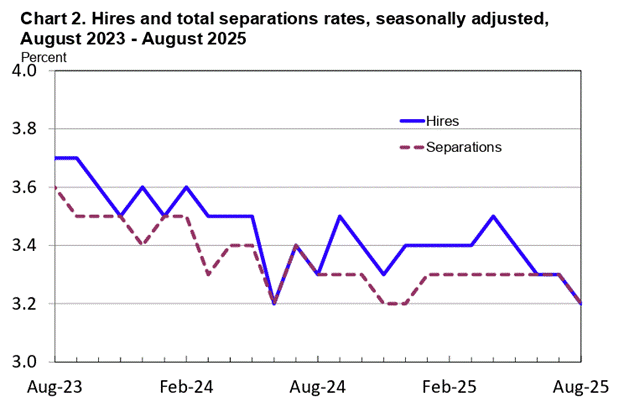
The number of U.S. job openings in August stood at 7.2 million, unchanged from July. Job openings decreased in construction (-115,000) and federal government (-61,000). The Job Openings and Labor Turnover Survey (JOLTS) results for August showed hires and separations in nearly lock step, both moving down slightly from 5.2 million to 5.1 million. The hires and total separations rates were 3.2% for the month, falling from 3.3% in July. Within separations, the number of quite was 3.1 million. Quits in accommodations and food services (-140,000) and arts, entertainment, and recreation (-22,000) decreased while they increased in construction (56,000). Layoffs and discharges were little changed at 1.7 million, with the number of layoffs and discharges falling in wholesale trade (-36,000) and federal government (-4,000). The number of other separations was little changed at 295,000. The other category represents separations due to retirement, death, disability, or transfers to other locations of the same firm. -Valorie Rice
In August, year-over-year metropolitan unemployment rates were higher in 243 of the 387 areas, lower in 115, and stable in the remaining 29, according to the October 1st Bureau of Labor Statistics’ metropolitan employment and unemployment summary. The non-seasonally adjusted August unemployment rates for the Phoenix and Tucson metro areas came in at 4.2% and 4.8%, respectively. Yuma had the highest unemployment rate in Arizona at 18.2%, while Phoenix had the lowest. In August, Sioux Falls, SD, had the lowest unemployment rate at 2.1%, and El Centro, CA, had the highest rate at 21.5%. The largest year-over-year increases occurred in Brownsville-Harlington, TX, and Eagle Pass, TX (+2.0 percentage points), and Kokomo, IN, had the largest decrease (-4.5 percentage points). -Delaney O’Kray-Murphy
The total number of building permits in Arizona dwindled to 2,523 in August compared to 4,919 the same month last year, a 48.7% decrease. Single-family permits were similarly lower at 2,158, a 34.6% decrease over the year. Phoenix total building permits in August were 1,809, a 51.9% drop over the year. Single-family permits in Phoenix were 1,529 for the month, a decrease of 34.9%. Tucson also experienced a decline; single-family permits were 201 for the month, down 32.8%, and total permits were 257, down 44.3%. Most Arizona metropolitan areas reported a drop in building permits, as Lake Havasu City-Kingman, Prescott Valley-Prescott, and Yuma also had decreased permitting. Flagstaff and Sierra Vista-Douglas were the exceptions, with increases in both total and single-family permits. Nationally, total building permits were down 13.6% over the year, and single-family permits were down 15.9%. -Valorie Rice