
Arizona’s Economy Rebounds After a Weak 2025
First Quarter 2026 Forecast Update
By George W. Hammond, Research Professor, EBRC
March 2026
Arizona’s economy sputtered last year, according to the preliminary data, with unusually slow job and income growth. Slow job gains were driven by big declines in firm hiring rates and modestly elevated layoffs, which, in turn, seem to be related to elevated federal economic policy uncertainty, increased tariffs, reduced immigration, elevated interest rates, and increased deportations. In better news, Phoenix inflation remained below the national average, with rent and house price growth greatly reduced. Even so, housing cost burdens stayed very high and housing permits declined. Finally, taxable sales growth in retail plus remote sellers rebounded in 2025, over 2024, but lost momentum in the second half of the year.
The forecast calls for Arizona growth to rebound modestly in 2026 and 2027, with somewhat faster gains in job and income growth. Even so, job gains remain weak compared to our own past history, weighed down by federal economic policy uncertainty, elevated tariffs, reduced international migration, increased deportations, and aging of the labor force. Population growth decelerates through the forecast, driven primarily by demographic pressures on natural increase, which put downward pressure on housing permits. These forecasts do not include possible economic impacts of the current war in the Middle East.
Arizona Recent Developments
The preliminary estimates for 2024 and 2025 suggest that the state added just 17,100 jobs last year, for 0.5% growth (not seasonally adjusted). That was equal to the revised national pace of 0.5%. Arizona’s preliminary estimates will be revised in April.
Phoenix MSA jobs rose 21,700 over the year in December, accounting for 88.2% of state job growth. That translated into growth of 0.9%. Preliminary estimates for 2024 and 2025 suggest that Phoenix added 14,200 jobs in 2025, for 0.6% growth (not seasonally adjusted). These preliminary estimates will be revised in April.
Tucson MSA jobs dropped 1,900 over the year in December. That translated into a decrease of 0.5%. Preliminary estimates suggest that Tucson jobs were roughly stable on average last year, compared to 2024 (not seasonally adjusted. These preliminary estimates will be revised in April.
Prescott MSA jobs fell 100 over the year in December, which translated into a 0.1% decline. Preliminary estimates indicate that Prescott lost nearly 400 jobs in 2025, compared to 2024. That was a drop of 0.5% (not seasonally adjusted). These preliminary estimates will be revised in April.
Overall, slow job gains in 2025 were driven by significant declines in the pace of hiring by firms, as well as modest increases in layoffs. In turn, reduced hiring is likely related to elevated federal economic policy uncertainty, increased tariffs, reduced immigration, and increased deportations. While increased use of artificial intelligence is impacting some pockets of the labor market, it does not yet appear to be generating large-scale labor market disruptions. Those may well be on the horizon, however.
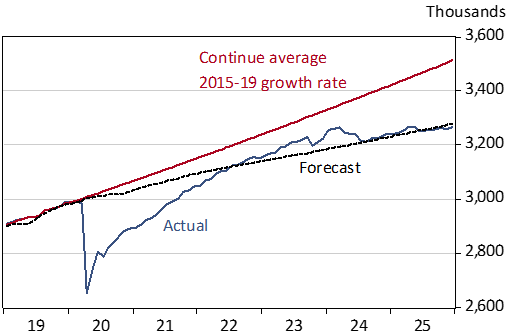
Overall, state jobs are still roughly tracking the pre-pandemic EBRC forecast trend (Exhibit 1). The same is true for the Phoenix MSA, with jobs in 2025 close to the predicted level from the EBRC First Quarter 2020 forecast. However, the Tucson MSA has lagged well behind employment levels expected before the pandemic started.
Exhibit 1: Actual and Forecast Arizona Total Nonfarm Jobs, Forecast from First Quarter 2020
Year to date through the third quarter of 2025, Arizona personal income was up 4.4%, well below the national pace of 4.9% and ranking the state 42nd in the nation. South Dakota posted the fastest increase (up 6.3%), while Maryland posted the slowest gain (at 3.6%).
On an over-the-year basis, Arizona net earnings by place of residence rose 3.3% in the third quarter, slower than the national pace of 4.2%. Income from dividends, interest, and rent rose 2.6% in Arizona, outpacing the U.S. at 2.1%. Transfer receipts rose 9.7% in Arizona, which was faster than the U.S. gain of 9.3%. Growth in net earnings lost momentum through the third quarter, while transfer receipts accelerated.
Net earnings by place of residence includes wages and salaries, fringe benefits, proprietors’ income, an adjustment for commuting, and is adjusted for contributions for social insurance. Transfer receipts includes Social Security, Medicare, Medicaid, and welfare payments.
Phoenix inflation has been below or close to the U.S. pace since 2023. Since mid-2025, local inflation has begun to accelerate back toward the national pace. In December 2025 (latest data), the Phoenix MSA all-items Consumer Price Index rose 2.2% over the year, compared to 2.7% for the U.S.
Even though the Phoenix shelter consumer price index has been roughly stable recently, it remains 37.6% above its December 2020 level. Further, the shelter price index increased far faster than incomes during the same period. That translates into a major increase in housing cost burdens (or a major drop in housing affordability). According to housing cost burden data from the Federal Reserve Bank of Atlanta through November 2025, the share of median income required for a mortgage (for the median-priced home) in the Phoenix MSA was 26.4% in December 2020. By November 2025 that share had risen to 43.6%. For the Tucson MSA, the share increased from 27.3% to 41.6% and nationally the share rose from 27.9% to 42.7%. For the Prescott MSA, the housing cost burden rose from 37.3% to 58.4%.
Statewide housing permits, after an initial surge in 2021, have fallen below their 2020 level. According to preliminary data from the U.S. Census Bureau, Arizona seasonally-adjusted total housing permits fell 14.0% from 2024 to 2025, driven primarily by an 18.7% decline in single-family permits. Multi-family permits declined 2.8%.
Phoenix MSA permits fell 14.1% from 2024 to 2025, with a 19.5% drop in single-family permits and a 3.6% decline in multi-family activity. Tucson MSA permits dropped 11.3%, with a 13.1% decline in single-family activity and a 4.6% decline in multi-family permits. Prescott MSA total permits fell 13.9%, with a 22.2% drop in single-family permits. In contrast to Phoenix and Tucson, multi-family permits rose 41.4% over the year in Prescott.
The decline in housing permits likely reflects a variety of factors impacting the industry, including high housing cost burdens (which in turn reflect high home prices and mortgage interest rates), tariff-driven increases in construction materials costs, and labor supply issues caused by the current federal administration’s focus on deportations.
Arizona Outlook
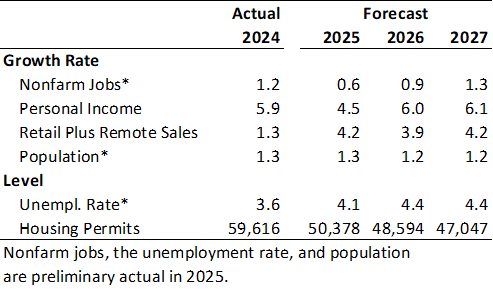
If the U.S. economy continues to grow, the baseline forecast calls for Arizona income and job growth to accelerate modestly next year (Exhibit 2). Keep in mind that these forecasts do not include possible economic impacts of the current war in the Middle East.
The current forecast calls for Arizona job growth to rise from 0.6% last year (preliminary, seasonally-adjusted annual average) to 0.9% this year and then again to 1.3% in 2027. In other words, it calls for the state job growth rate to roughly double over the next two years. Even so, 1.3% is weak job growth.
Population growth is projected to modestly decelerate from 1.3% in 2025 (actual) to 1.2% in 2026 and 2027. That reflects weakening natural increase (annual difference between births and deaths) and net migration.
On net, the population and job trends translate into only modest increases in the state’s unemployment rate, which rises from 4.1% (preliminary) in 2025 to 4.4% by 2027.
Job growth translates into gains in net earnings from work, which, combined with gains in transfer income and income from dividends, interest, and rent, generates an increase in personal income growth from 4.5% in 2025 to more normal rates of 6.0% in 2026 and 6.1% in 2027.
Exhibit 2: Arizona Short-Run Outlook
The forecast patterns are similar for both the Phoenix and Tucson metropolitan areas. Specifically, the current forecast calls for job growth in the Phoenix MSA to rise from 0.6% (preliminary) in 2025 to 1.1% in 2026, and again to 1.4% by 2027. As with the state, that is still slow job growth. Population growth in Phoenix is forecast to remain steady at 1.5% in 2026, before slowing to 1.4% in 2027.
Growth rates are expected to be much slower for the Tucson MSA (compared to Phoenix), even though they are expected to improve a bit. The forecast calls for job growth to improve from 0.0% (no growth) in 2025 (preliminary) to 0.3% in 2026 and 0.5% in 2027. Population growth is forecast to slow from 0.7% in 2025 to 0.6% in 2026 and 2027, driven by deteriorating in natural increase.
VIEW MOST RECENT FORECAST DATA FOR ARIZONA, PHOENIX, AND TUCSON
If your business or organization requires more timely and in-depth forecast data and analysis, find out about the benefits of joining EBRC’s Forecasting Project and email EBRC research professor George Hammond at ghammond@arizona.edu.
Copyright 2026 Economic and Business Research Center, The University of Arizona, all rights reserved.