Arizona’s Housing Mix Shifts Sharply in January
By: EBRC Research Staff
Current data as of 19 March 2026
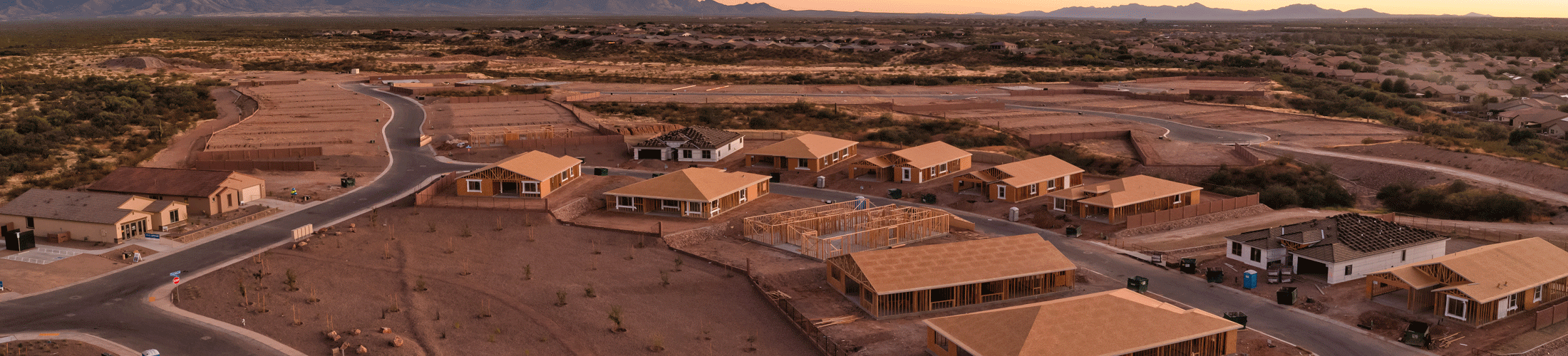
In January, Arizona year-over-year total building permits saw a notable 22.1% decrease to 2,859, not seasonally adjusted. The number of single-family permits in the state also fell 33.7% to 2,240, while the number of five or more unit permits surged 278.9% to 557. The Phoenix Metropolitan area experienced a similar trend to the state, with single-family permits falling 21.3% to 2,114, and five or more unit permits rising 440.9% to 476. Building permits in the Tucson Metropolitan area saw losses in both single- and five or more-unit permits, with the former falling 7.6% to 326 and the latter decreasing 54.2% to 27. Of the counties, Apache, Coconino, and Yuma saw increases while Cochise, Gila, Graham, Maricopa, Mohave, Navajo, Pinal, Santa Cruz, and Yavapai observed decreases in year-over-year total building permits. -Delaney O’Kray-Murphy
The U.S. Consumer Price Index for All Items rose 0.3% over the month in February, slightly faster than the January gain of 0.2%. The shelter index was the driving factor in the February increase. The all-items index was up 2.4% over the year in February, the same as the prior month. The all-items less food and energy index was up 2.5% over the year. The gasoline index was down 5.6% over the year, while the electricity index was up 4.8%.
Phoenix MSA all-items inflation 1.7% over the year in February, well below the national pace. The all-items less food and energy index also rose 1.7%. Consumer commodities prices were up 1.0%, while services were up 2.2%. The Phoenix shelter index rose 0.3%. -George Hammond
Less than half of the nation’s large counties experienced job growth between September 2024 and September 2025 based on the most recent U.S. Bureau of Labor Statistics Quarterly Census Employment and Wages (QCEW) release. Boone County, KY, had the largest increase in employment over the year at 3.8%, followed by Benton County, AR, at 3.6%. The county with the biggest decline in employment over the year was Washington County, OR, with -3.9%. The three largest counties in Arizona observed a mix of job loss and gain. Pinal County reported a 1.9% increase in employment for that period, while both Maricopa and Pima counties lost jobs, indicating -0.4% and -0.5%, respectively. Nationally, jobs increased by just 0.1%. The one-year change in average weekly wages for the third quarter of 2025 was positive for the three largest counties in Arizona, with Maricopa increasing by 4.1%, Pima by 3.5%, and Pinal by 4.5%. Nationally, average weekly wages increased 4.7% for that period, while other counties in the nation ranged from an increase of 31.7% in San Mateo County, CA, to a decline of 8.0% in Midland County, TX. -Valorie Rice
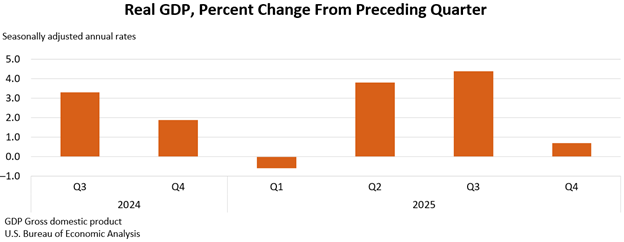
Real gross domestic product (GDP) increased at an annual rate of 0.7% in the fourth quarter of 2025, according to the second estimate released by the U.S. Bureau of Economic Analysis. In the advanced estimate, the increase in real GDP was reported at 1.4%, indicating downward revisions to exports, consumer spending, government spending, and investment. Compared to the third quarter, the deceleration in real GDP in the fourth quarter reflected downturns in government spending and exports and a deceleration in consumer spending that was partly offset by an acceleration in investment. Current-dollar GDP and real final sales to private domestic purchasers were both revised down around half a percentage point, while the gross domestic purchases price index rose a tenth of a percentage point. In 2025, real GDP increased 2.1%, revised down 0.1 percentage points from the prior estimate. -Delaney O’Kray-Murphy
The number of job openings in the U.S. was little changed from December to January at 6.9 million and a rate of 4.2%, with the number of openings in finance and insurance increasing 184,000. Hires were unchanged at 5.3 million, though there were decreases in transportation, warehousing, and utilities (-67,000) and in real estate and rental and leasing (-20,000). The January Job Openings and Labor Turnover Survey (JOLTS) release indicated that the number of total separations was little changed at 5.1 million. Within total separations, the number of quits was 3.1 million and layoffs, and discharges were 1.6 million, both changing little over the month. The number of quits increased in private educational services. This release included 2025 annual data. The annual average job openings level for 2025 was 7.1 million, a decrease of 571,000 from 2024. The annual hires level of 63.0 million in 2025 was 1.5 million lower than in 2024. The annual total separations level also decreased over the year to 62.8 million in 2025, 251,000 lower than the year prior. -Valorie Rice
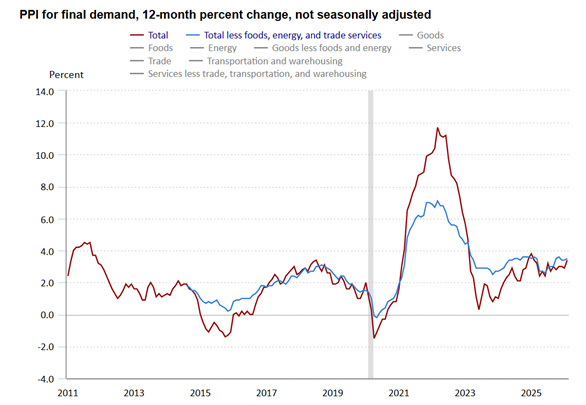
The U.S. Producer Price Index for final demand rose 0.7% in February 2026, up from 0.5% in January. The February increase was driven primarily by services (with strong gains in accommodation services), although goods prices were up substantially as well (especially foods, like fruits and vegetables). Over the year, the final demand index was up 3.4%, its fastest increase in a year. The price index for processed goods for intermediate demand increased rapidly in February (up 1.6%), driven in part by increased diesel fuel prices. Unprocessed energy goods prices (natural gas) were the major factor driving the index for unprocessed goods for intermediate demand up by 3.1%. Over the year, the processed goods index was up 4.0%, and the unprocessed goods index was down 1.7%. -George Hammond
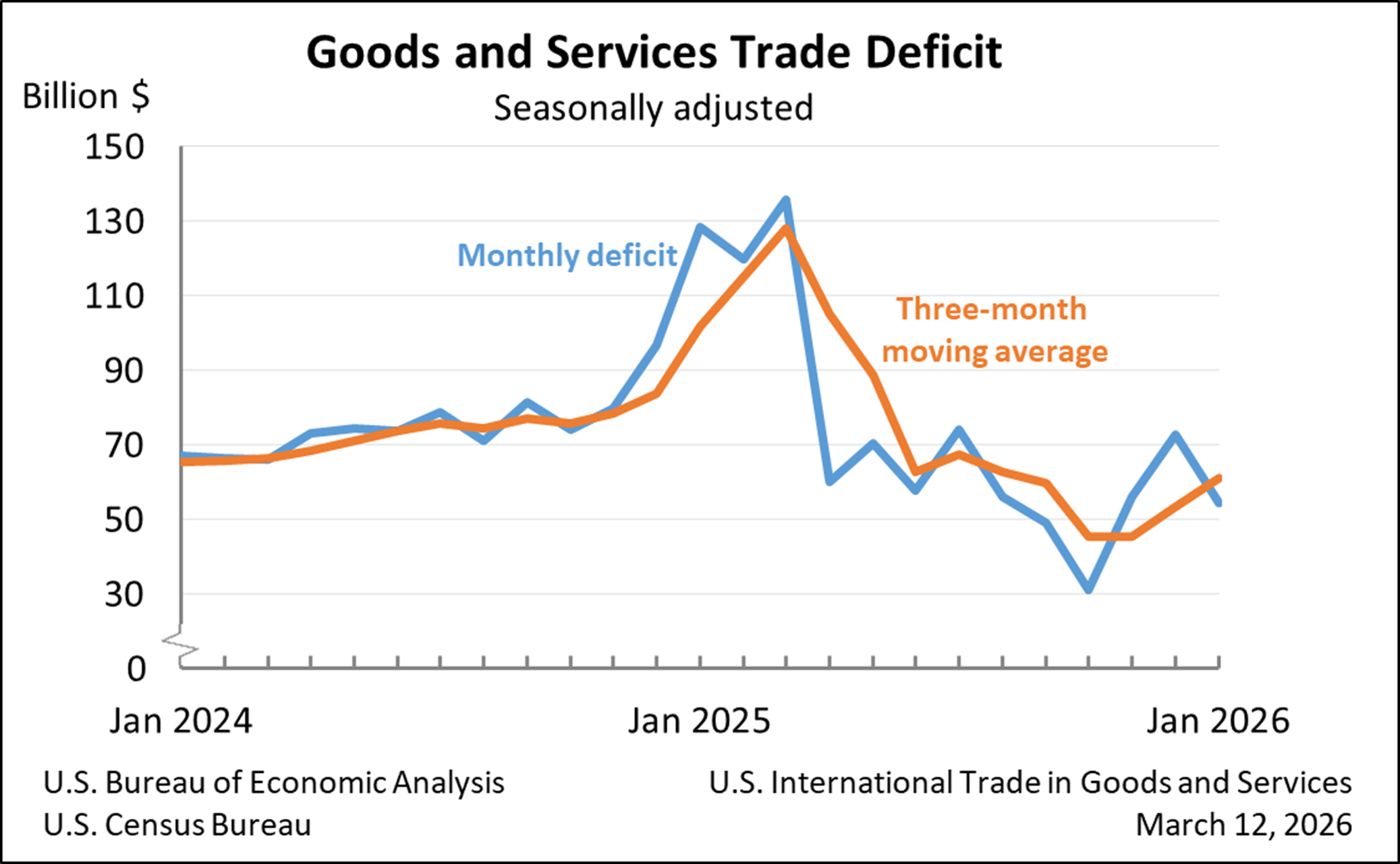
The January goods and services trade deficit came in at $54.5 billion, down $18.4 billion from a revised $72.9 billion in December, according to the Bureau of Economic Analysis’ March 12th release. January exports rose $15.8 billion to $302.1 billion, and imports fell $2.6 billion to $356.6 billion. The decrease in the deficit reflects a decrease in the goods deficit of $17.5 billion to $81.8 billion and an increase in the services surplus of $1.0 billion to $27.3 billion. Year-over-year, the goods and services trade deficit decreased $73.9, or 57.6%, from January 2025. The largest surpluses, in billions, occurred with United Kingdom ($7.0), Netherlands ($6.4), and South and Central America ($4.5), while the greatest deficits were with Vietnam ($19.0), Taiwan ($17.3), and Mexico ($12.8). -Delaney O’Kray-Murphy