April Jobless Rates Hold Steady in Most States, Including Arizona
EBRC Research Staff
Current data releases as of 29 May 2025
In April, over the month state unemployment rates were higher in 3 states and the District of Columbia, lower in 2 states, and stable in the remaining 45, according to the Bureau of Labor Statistics. Arizona’s seasonally adjusted unemployment rate remained the same over the month at 4.1%, and the national average stayed at 4.2%. South Dakota had the lowest jobless rate in April at 1.8%, and the District of Columbia had the highest rate at 5.8%. 26 states and the District of Columbus saw unemployment rate increases over the year, the largest being Mississippi (+1.2 percentage points) and Michigan (+1.1 percentage points). The only over-the-year decrease occurred in Montana (0.3 percentage points). 23 states had jobless rates not noticeably different from those a year prior. -Delaney O’Kray-Murphy
In April, over-the-year metropolitan unemployment rates were higher in 286 of the 387 metropolitan areas, lower in 72, and unchanged in the remaining 29, according to the latest Bureau of Labor Statistics report. The April unemployment rates for the Tucson and Phoenix metropolitan areas came in at 3.5% and 3.1%, respectively. Yuma had the highest unemployment rate in Arizona at 11.3%, while Phoenix had the lowest. Rapid City, SD, and Sioux Falls, SD-MN, had the lowest unemployment rates at 1.8% each, while El Centro, CA, had the highest rate at 16.0%. The largest year-over-year unemployment rate increase occurred in Eagle Pass, TX (+2.6 percentage points). Kankakee, IL, and Rockford, IL, had the largest over-the-year rate decreases at -1.4 percentage points each. -Delaney O’Kray-Murphy
According to the May 20th State Job Openings and Labor Turnover (JOLTS) report, the job openings rates decreased in three states, increased in three states, and were little changed in all other states. The job openings rates for Arizona were 5.0% for March, 5.2% for February, and 6.9% for January.
The number of job openings decreased in five states and were little changed in all other states. The largest decrease in the job openings level was seen in Massachusetts (-59,000). Hire rates decreased in two states, increased in three states, and were little changed in all other states. The hire rates for Arizona were 3.6% for March, 3.6% for February, and 3.5% for January. The number of hires decreased in two states, increased in four states, and little changed in all others. The largest increase in hire levels was in Michigan (+40,000). The number of layoffs and discharges decreased in ten states and were little changed in all other states. The largest decrease in the layoffs and discharges level occurred in Massachusetts (-35,000). Nationally, the layoffs and discharge rates were little changed. -Alex Jaeger
In April, over the year building permits saw a 2.3% decrease to 5235, not seasonally adjusted, according to the Census Bureau’s Building Permits Survey (BPS). The number of single-family units similarly fell, with permits dropping 14.2% to 3209. The Phoenix MSA (Maricopa and Pinal) accounted for most of the permits in the state, with 3923, a 4.5% decrease year-over-year. The number of single-family permits fell 10.6% to 2338. The Tucson MSA fared similarly, with total permits falling 12.6% to 411 and single-family permits falling 13.3% to 340. Of the counties, Coconino, Graham, Santa Cruz, Yavapai, and Yuma all saw increases, while Apache, Cochise, Gila, Maricopa, Mohave, Navajo, and Pinal saw decreases. No changes were observed in La Paz. -Delaney O’Kray-Murphy
Phoenix house prices rose 1.9% over the year in March based on the most recent S&P CoreLogic Case-Shiller Indices. This was below the national annual price gain of 3.4% for the month. The 20-city composite increased 4.1%. New York had the highest increase in house prices again in March, at 8.0%. Chicago and Cleveland also had notable price gains at 6.5% and 5.9%, respectively. Tampa was the only area to post a decrease in house prices over the year for March, at -2.2%. This was the fifth consecutive month of decreased house prices in Tampa. -Valorie Rice
A typical family in the U.S. would spend 35% of their income to purchase a median-priced existing home during the first quarter of 2025. This is the same amount as a family in Tucson earning a median income (35%), according to the National Association of Home Builders (NAHB)/Wells Fargo Cost of Housing Index (CHI). This was a slight improvement over the fourth quarter of 2024 for Tucson and nationally, as they had both required 37%; however, anything over 30% is still considered housing-cost burdened. Income gains and lower house prices helped to improve affordability. Phoenix was the only other Arizona metropolitan area listed on the CHI, and it took 38% of the median family income there to purchase a median-priced home in the first quarter of this year. A few of the least cost-burdened areas of the country during the first quarter were in Illinois, with families in Decatur, Peoria, and Springfield- all needing to spend 16% of their income on a median-priced home. On the other end of the spectrum, California posted several areas among the heaviest cost-burdened markets nationally, with 88% of a typical family’s income going to afford a mortgage for an existing home in San Jose, and 68% required in San Diego followed by 64% in San Francisco. -Valorie Rice
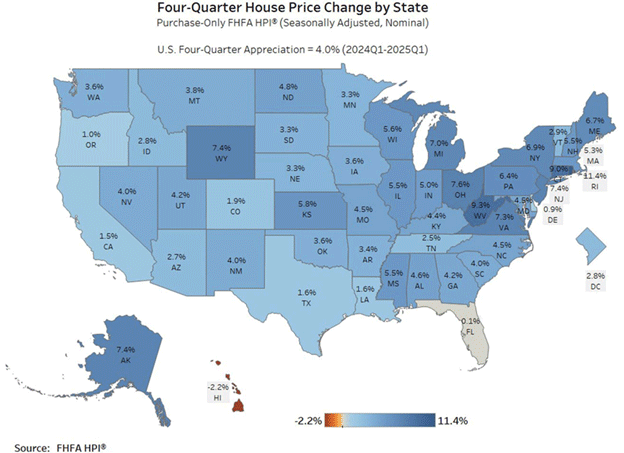
House prices appreciated 2.7% in Arizona between the first quarter of 2024 and the first quarter of 2025. This was below the national rate of 4.0% based on the U.S. Federal Housing Finance Agency (FHFA) quarterly House Price Index. Rhode Island topped all states for annual house price increases at 11.4%, followed by West Virginia at 9.3% and Connecticut at 9.0%. Only one state experienced a decline in house prices, Hawaii at -2.2%. The state and national house price changes are based on a purchase-only index. House prices for Arizona metropolitan areas are available on an all-transactions basis, using sales prices and appraisal data. The one-year change in prices was 4.6% in Lake Havasu City-Kingman, 4.1% in Tucson, 3.8% in Flagstaff, 2.7% in Sierra Vista-Douglas, 2.0% in Phoenix, 1.7% in Prescott Valley-Prescott, and 0.9% in Yuma. For comparison, the year-over-year all-transaction index change for Arizona and the U.S. in the first quarter of 2025 was 2.7% and 4.7%, respectively. -Valorie Rice
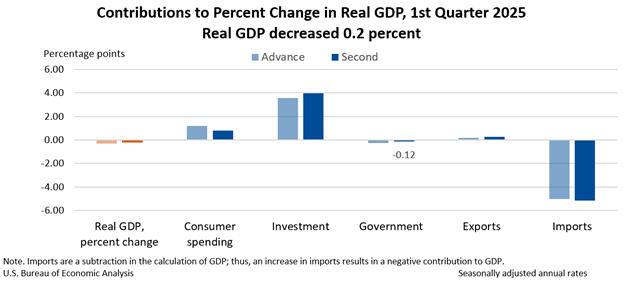
Real gross domestic product (GDP) decreased at an annual rate of -0.2% in the first quarter of 2025, according to the second estimate released by the Bureau of Economic Analysis. In the first estimate, the decrease was -0.3%. This update primarily reflects an upwards revision to investment that was partly offset by a downward revision to consumer spending. Current-dollar GDP increased 3.4% over the quarter, a -0.1-percentage point revision from the advanced estimate. Real GDI came in at -0.2%, the same as real GDP. The personal consumption expenditures (PCE) price index increased 3.6%, the same as previously estimated. Excluding food and energy prices, the PCE price index increased 3.4%, revised down 0.1 percentage point from the prior estimate. -Delaney O’Kray-Murphy