
Arizona GDP Drops 0.5% in Q1, Matching National Decline
EBRC Research Staff
Current data releases as of 27 June 2025
Real gross domestic product (GDP) decreased at an annual rate of 0.5% in the first quarter of 2025, according to the third (final) estimate released by the Bureau of Economic Analysis. In the second estimate, the decrease in real GDP was 0.2%. This update primarily reflects downward revisions to consumer spending and exports that were partially offset by a downward revision to imports. Current-dollar GDP increased 3.2% at an annual rate, a downward revision of 0.2 percentage points. The personal consumption expenditures (PCE) price index increased 3.7%, a 0.1 percentage point upward revision. Real gross domestic income (GDI), an alternative measure of GDP, increased by 0.2% in the first quarter, a 0.4 percentage point upward revision. -Delaney O’Kray-Murphy

Total nonfarm employment in Arizona increased by 18,300 jobs over the year in May, with the seasonally adjusted unemployment rate remaining at 4.1%. The U.S. seasonally adjusted unemployment rate remained at 4.2%, unchanged from April. Arizona’s non-seasonally adjusted total nonfarm employment decreased by 19,300 jobs in May, worse than the pre-pandemic average of -6,700. Employment gains were reported in Health Care and Social Assistance (2,300), Financial Activities (500), and Natural Resources & Mining (100). Employment losses occurred in Government (-7,200), Professional & Business services (-4,100), Private Educational Services (-4,100), Trade, Transportation, & Utilities (-3,100), Construction (-1,700), Other Services (-800), Leisure & Hospitality (-600), Manufacturing (-300), and Information (-300). -Delaney O’Kray-Murphy

In May, over-the-month state unemployment rates were higher in three states, lower in two, and stable in the remaining 45 and the District of Columbia. Arizona’s seasonally adjusted unemployment rate remained the same over the month at 4.1%. South Dakota had the lowest unemployment rate in May at 1.8%, while the District of Columbia had the highest at 5.9%, followed by Nevada at 5.5%. 24 states and the District of Columbia had unemployment rate increases over the year, the largest of which was in Mississippi (+1.2 percentage points), while four states had unemployment rate decreases, the largest of which was Indiana (-0.4 percentage points), followed by Illinois, New York, and West Virginia (-0.3 percentage points). -Delaney O’Kray-Murphy
According to the June 18th State Job Openings and Labor Turnover (JOLTS) report, the job openings rate increased in four states and changed little in all other states. The job openings rate for Arizona dropped to 4.5% in April after 5.1% in March, and 5.2% in February. The number of job openings decreased in three states, increased in five states, and changed little in all other states. The largest increase in the job openings level occurred in New York (+61,000). Arizona was one of the three states to see a decrease in the job openings level (-23,000). Hire rates decreased in two states, increased in four states, and changed little in all other states. The hire rate for Arizona slowed to 3.5% in April after 3.7% in March and 3.6% in February. The number of hires decreased in two states, increased in four states, and changed little in all others. The largest increase in hire levels was in California (+109,000). The number of layoffs and discharges decreased in three states, increased in eight states and changed little in all other states. The largest increase in the layoffs and discharges level occurred in Florida (+39,000). Nationally, the layoffs and discharge rates were little changed. -Alex Jaeger
Nationally, Real GDP decreased at an annual rate of 0.5% in the first quarter of 2025, with 39 states experiencing declines in GDP. Arizona ranked in the middle quintile with a 0.5% decrease in first-quarter GDP. South Carolina ranked first with growth of 1.7%, while Iowa and Nebraska sat last with -6.1%. Finance and Insurance; agriculture; forestry, fishing, and hunting; and wholesale trade were the leading contributors to the decrease in GDP nationally.

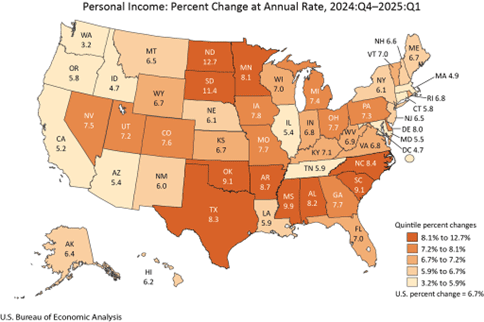
Personal income, in current dollars, increased in all 50 states and the District of Columbus in the first quarter of 2025, with the percent change ranging from 12.7% at an annual rate in North Dakota to 3.2% in Washington state. Arizona ranked in the lowest quintile with 5.4% growth. Nationally, personal income increased 6.7%, or $407.3 billion. Increases in earnings, transfer receipts, and property income contributed to the rise in personal income. -Delaney O’Kray-Murphy
U.S. house prices rose 2.7% over the year in April, a decrease from the 3.4% figure presented in March, based on the S&P CoreLogic Case-Shiller June 24th release. Phoenix and Las Vegas both showed increases in house prices over the year, with the Phoenix index rising 1.3% and the Las Vegas index increasing 4.1%. Both the 10-City composite and the 20-City composite saw over-the-year increases of 4.1% and 3.4%, respectively. New York reported the highest annual gain among the 20-city composite with a 7.9% increase in April, followed by Chicago and Detroit with an increase of 6.0%. Tampa posted the lowest return, falling 2.2%. -Delaney O’Kray-Murphy
In May, Arizona over-the-year building permits saw a 0.6% increase to 4515, not seasonally adjusted. The number of single-family permits decreased by 16.2% over the year to 3,236. The Phoenix Metro area accounted for most of the permits in the state, with 3,469, an 8.2% increase since last May. On the other hand, Tucson housing permits declined by 12.7% to 406. Of the counties, Apache, Graham, Maricopa, and Santa Cruz all saw increases over the year, while Cochise, Coconino, Gila, Mohave, Navajo, Pinal, Yavapai, and Yuma all saw decreases. No changes were seen in La Paz. -Delaney O’Kray-Murphy