
Tentative Labor Stability Amid Energy-Led Inflation
By: EBRC Research Staff
Current data as of 12 June 2026
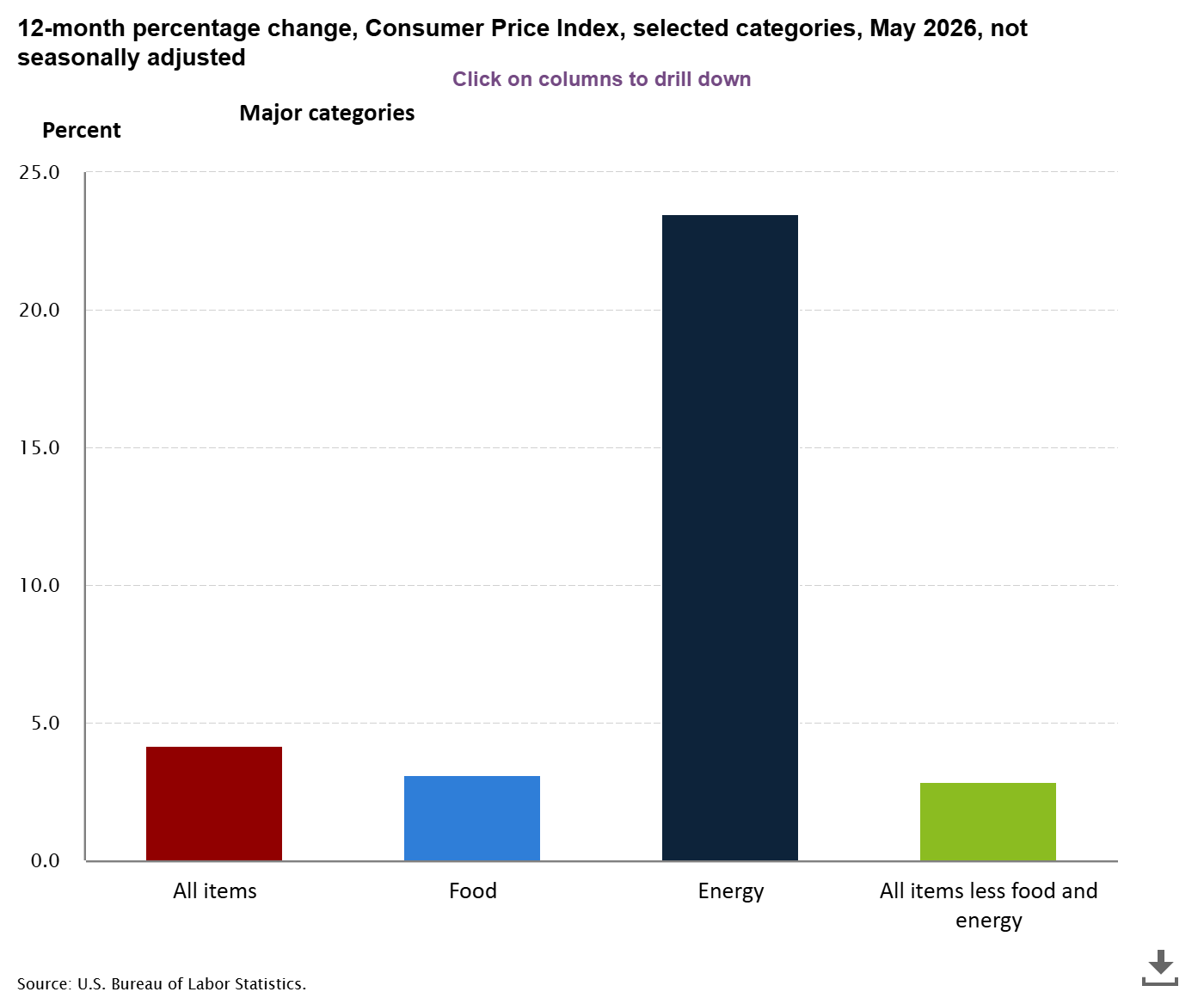
The U.S. all-items Consumer Price Index rose 0.5% over the month in May, after rising 0.6% in April. The all-items index rose 4.2% over the year in May, up from 3.8% in April. The energy index accounted for 60% of the all-items monthly increase in May. The index for all items less food and energy rose 0.2% over the month in May and 2.9% over the year. The energy index was up 23.5% over the year in May, while the food index rose 3.1%. Overall, the war with Iran has significantly impacted the pace of U.S. inflation during the past three months. – George Hammond
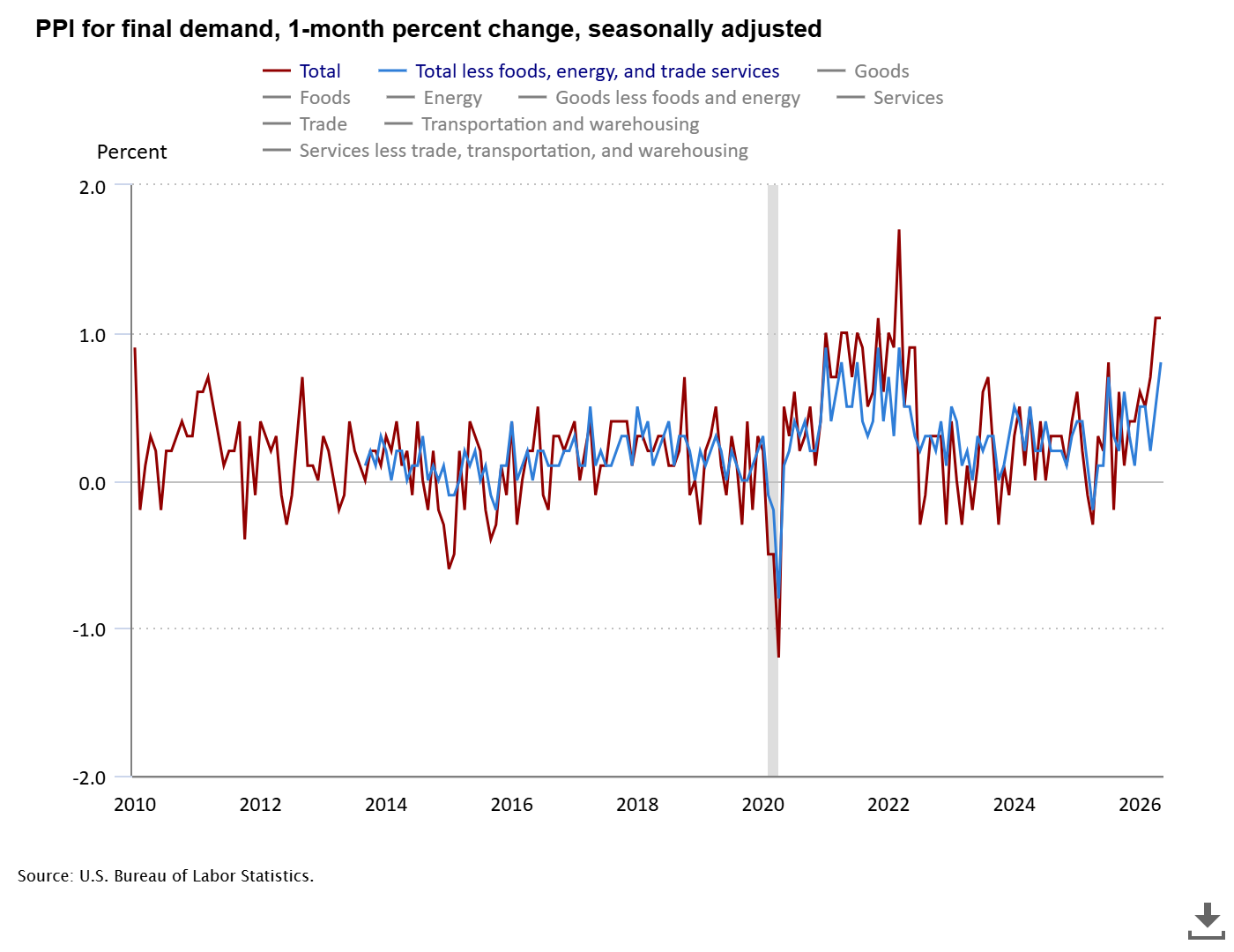
The U.S. Producer Price Index for final demand rose 1.1% over the month in May, equal to the April increase. The May increase was primarily driven by final demand goods, with energy prices fueling the gain. The final demand index was up 6.5% over the year, its fastest pace since November 2022. The index for processed goods for intermediate demand rose 3.5% over the month in May, its fastest rise since March 2021. Again, rising energy prices (primarily diesel fuel) drove the gain. Energy prices were also primarily responsible for the rapid 4.9% over-the-month increase in the index for unprocessed goods for intermediate demand. – George Hammond
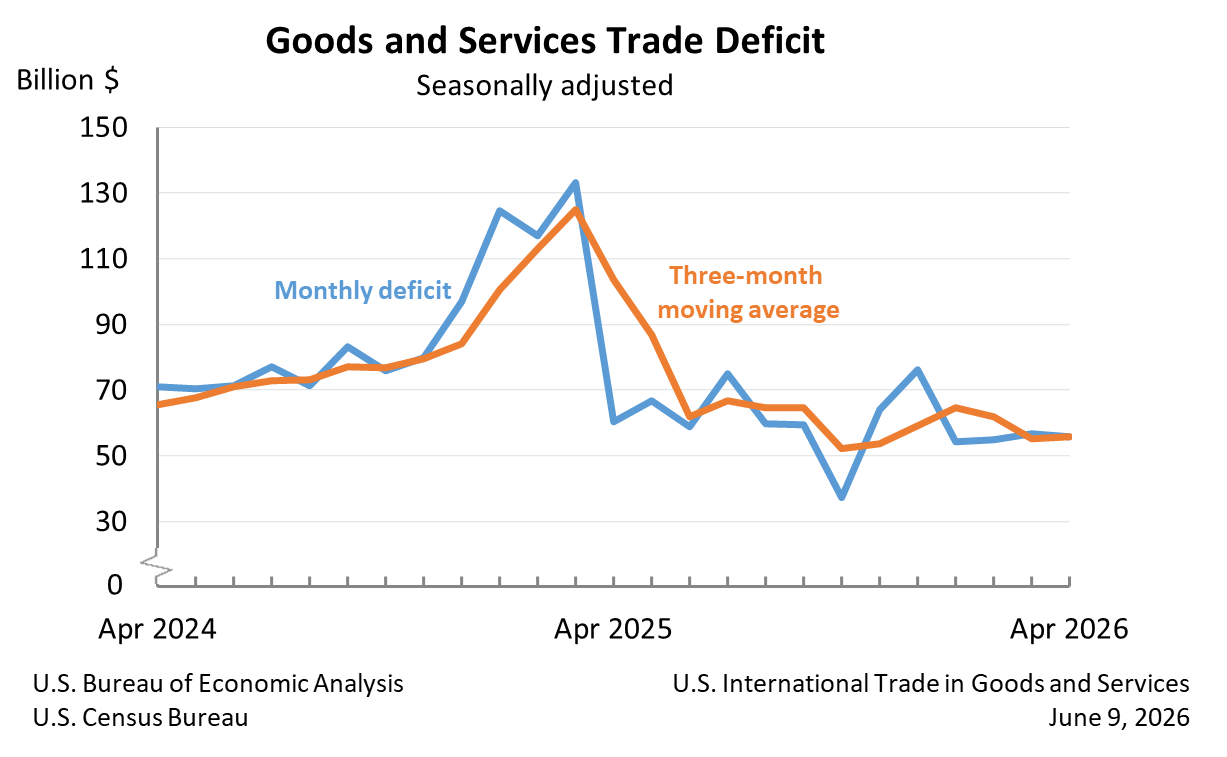
The U.S. trade deficit stood at $55.9 billion in April, down from a revised March figure of $56.6 billion. The three-month moving average for the goods and services trade deficit was $55.8 billion ending in April. Imports and exports were both up over the month with imports rising $7.6 billion and exports increasing by $8.3 billion. Year-to-date, the goods and services deficit reflected a 49.1% drop compared to the same period last year. The countries the U.S. ran the highest surpluses within April were, in billions of dollars, Netherlands ($8.5), South and Central America ($7.8), Hong Kong ($6.1), and Switzerland ($4.4). The highest deficits for trade were with Taiwan ($19.3), Vietnam ($19.3), Mexico ($14.8), and China ($12.0). – Valorie Rice
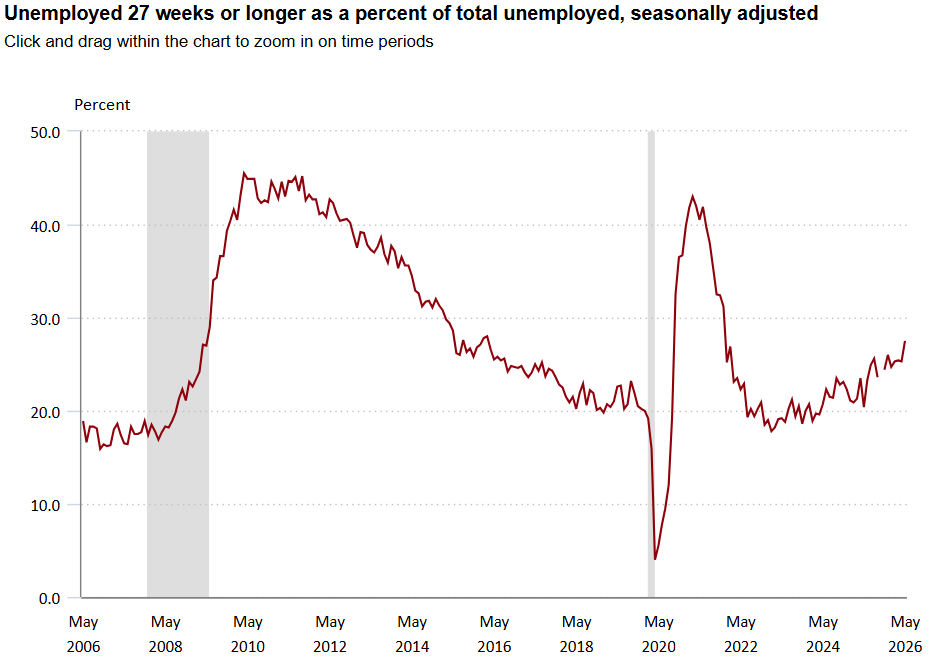
The U.S. unemployment rate changed little at 4.3% in May, with total nonfarm payroll jumping by 172,000, according to the Bureau of Labor Statistics’ June 5th employment situation summary. The unemployment rates for major worker groups showed little or no change in May, and the number of people jobless for less than 5 weeks declined. The number of long-term unemployed (those jobless for 27 weeks or more) changed little over the month at 2.0 million but is up by 524,000 over the year. Payroll employment surged by 70,000 in Leisure and Hospitality over the month, with food services and drinking places adding 48,000 jobs. Employment increases were solid in Local Government (55,000), Health Care (35,000), and Social Assistance (12,000), while Financial Activities payrolls declined by 22,000.– Niaoniao You
Source: U.S. Bureau of Labor Statistics.
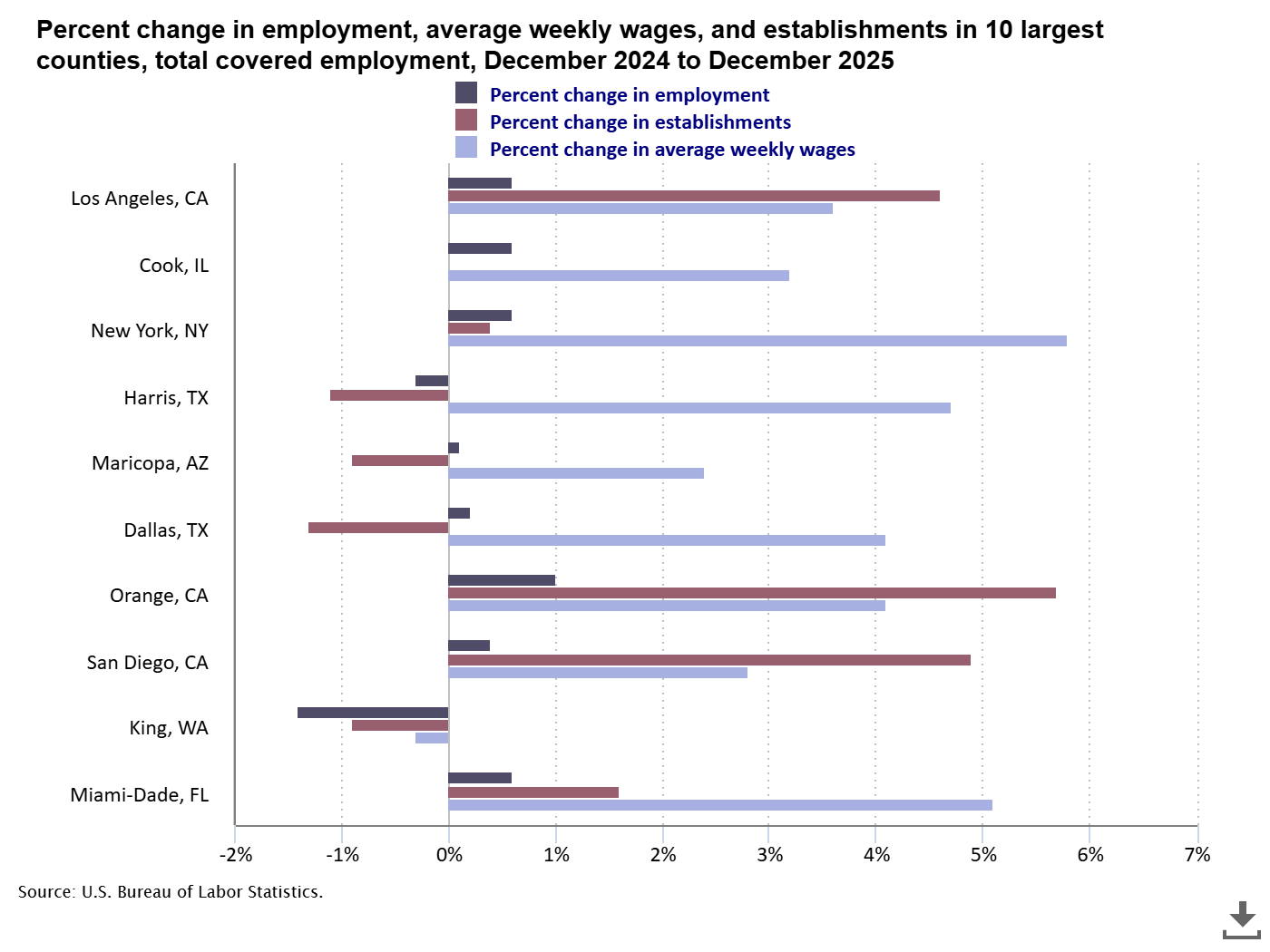
Less than half of the nation’s large counties experienced job growth between December 2024 and December 2025 based on the most recent U.S. Bureau of Labor Statistics Quarterly Census Employment and Wages (QCEW) release. Nationally, jobs increased by just 0.2% for that period, and average weekly wages increased 4.2%. Total employment levels were revised slightly up for the first three quarters of 2025 along with this release. The three largest counties in Arizona observed a mix of job loss and gain. Pinal County reported a 3.0% increase in employment from December 2024 to December 2025, while both Maricopa and Pima counties lost jobs, indicating -0.1% and -0.8%, respectively. In Maricopa County, the one-year change in average weekly wage growth grew slower than the national average growth at 2.3%, whereas Pima and Pinal counties saw faster growth at 4.8% and 6.4%, respectively. – Niaoniao You
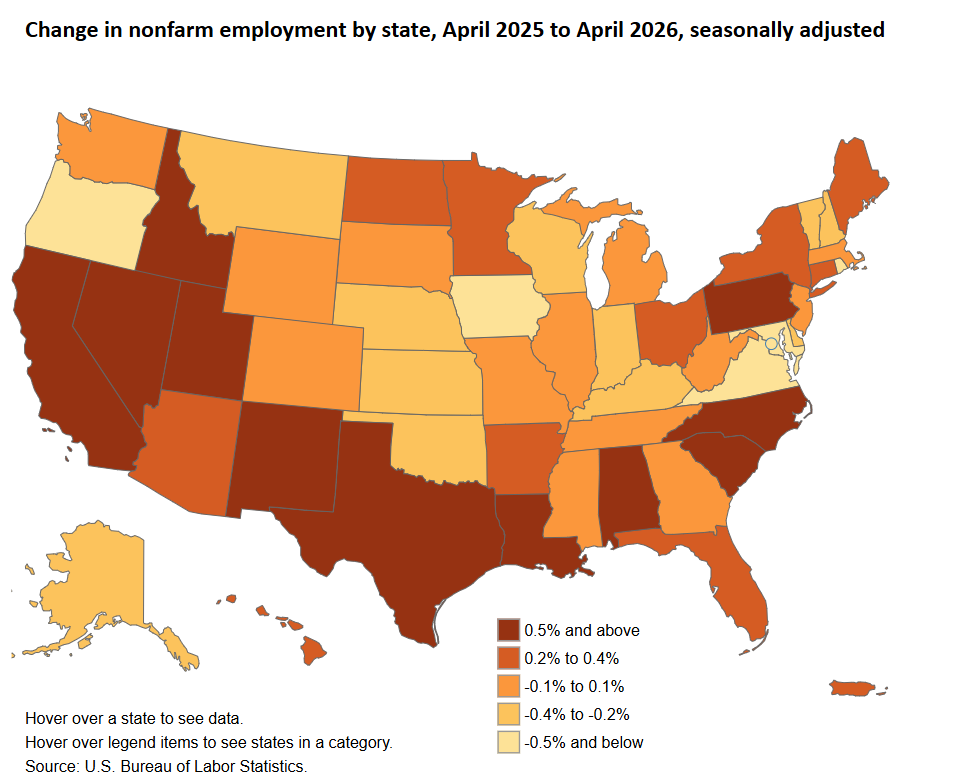
In April, year-over-year metropolitan unemployment rates were higher in 200 of the 387 metropolitan areas, lower in 152 areas, and unchanged in the remaining 35. The unemployment rates for the Tucson and Phoenix metropolitan areas came in at 4.4% and 3.8%, respectively. Yuma had the highest unemployment rate in Arizona at 13.9%, while Phoenix had the lowest. Rapid City, SD, and Sioux Falls, SD-MN, had the lowest unemployment rate for the month at 1.7%, while El Centro, CA, had the highest unemployment rate at 16.5%. Over the year, nonfarm payrolls increased by 15,400 in Phoenix and by 7,700 in Flagstaff, while other metro areas in Arizona saw slight decreases.
Month-over-month state unemployment rates were lower in 3 states, higher in 2 states, and stable in the remaining 45 states and the District of Columbia. Arizona’s seasonally adjusted unemployment rate was unchanged month-over-month at 4.7%, while the nation held at 4.3%. South Dakota had the lowest jobless rates in April at 2.2%, while the District of Columbia had the highest rate at 6.2%, followed by California, Delaware, and Nevada at 5.3% each. Nineteen states had unemployment rate increases year over year, the largest of which were in Connecticut (+1.2 percentage points) and Florida (+1.1 percentage points). Six states had year-over-year rate decreases, the largest of which was Ohio (-0.9 percentage points). – Niaoniao You
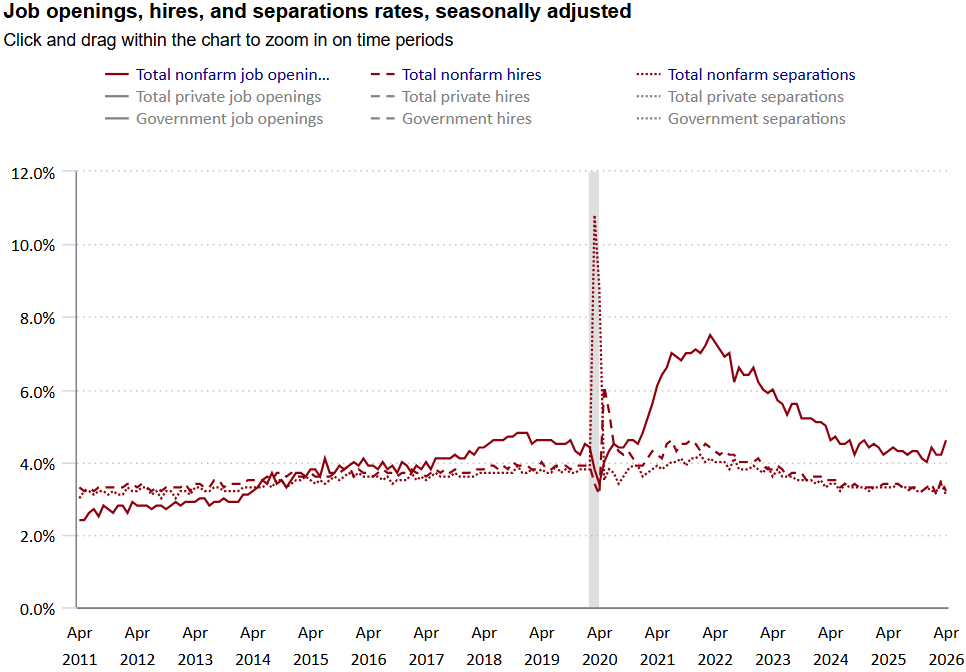
The number of job openings rose to 7.6 million in April from 6.9 million in March, according to the Job Openings and Labor Turnover Summary (JOLTS) released by the Bureau of Labor Statistics on June 2. Over the month, both hires and total separations declined, to 5.1 million and 5.0 million, respectively. Quits (3.0 million) and layoffs and discharges (1.7 million) changed little. The increase in the number of job openings was mostly from professional and business services (668,000) and from health care and social assistance (89,000). The rate of job openings rose to 4.6% from 4.2% in the previous month. The number of hires, however, decreased to 5.1 million (-419,000) and was down by 275,000 over the year, with the hire rate falling back to 3.2% after a rebound in March. Within separations, the number of total separations increased the most in state and local government (294,000), and the number of quits for that industry increased as well, by 22,000, while other industries saw little change or slight declines. – Niaoniao You
Source: U.S. Bureau of Labor Statistics.