
Arizona’s Economy Battered by Uncertainty
Second Quarter 2026 Forecast Update
By George W. Hammond, EBRC Research Professor
May 2026
PRESENTATION SLIDES: 2026 Eller Breakfast with the Economists
Arizona’s economy continues to be battered by uncertainty originating from the federal government, including both economic and geopolitical policies. With the outbreak of war in the Middle East, gas prices spiked during March/April and inflation picked up significant steam. Job growth was dismal last year, according to preliminary data, and is slow so far in 2026, primarily due to a dramatic slowdown in hiring. Income gains were slow last year as well and the state’s per capita personal income fell further behind the nation. While house price appreciation has moderated, housing cost burdens remain very much elevated, putting downward pressure on housing permit activity.
The baseline outlook calls for the state to continue to grow, and for growth to accelerate slightly in the near term, but the pace is expected to be unusually slow. Indeed, the forecast calls for job growth during the next decade to be one half of the average pace during the prior decade. Continued uncertainty related to federal policymaking drives much of the slow growth, with the added drag of growth-slowing policies like increased tariffs, reduced immigration, and mass deportations. Those policies are layered on top of elevated interest rates and continued demographic aging, which is contributing to slower labor force growth. While the baseline forecast calls for continued growth, the pessimistic scenario (assigned a 25% probability) warns of modest job loss this year and slow gains in 2027. These forecasts do not include the impact of major cuts to water from the Central Arizona Project.
Arizona Recent Developments
Gas prices spiked with onset of war with Iran. Phoenix regular gasoline rose from an average (seasonally adjusted) of $3.63 per gallon in January 2026 to $4.28 per gallon in April. That was an increase of 17.9%. Over the year, the Phoenix gas price was up 35.9%. However, as Exhibit 1 shows, Phoenix gas prices remained well below their recent peak of $5.39 per gallon in June 2022. After adjusting for inflation, current Phoenix gas prices are well below recent and historical highs.
Exhibit 1: Phoenix Regular Gasoline Prices, Dollars per Gallon, Real and Nominal
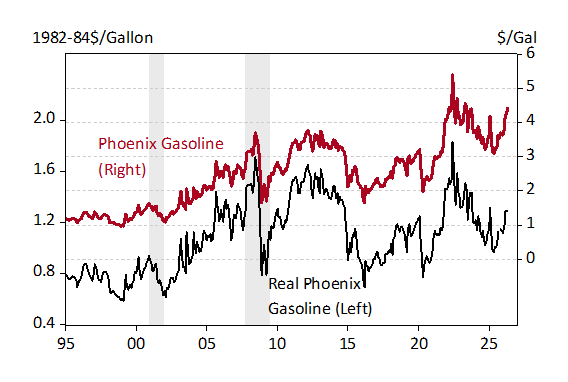
Even though gasoline prices are not (yet) particularly high by historic standards, the recent increases will nonetheless be a drag on consumer spending and overall economic activity in coming months.
Inflation has been picking up steam during recent months, reflecting the impact of tariffs and rising energy prices due to the war in Iran. Phoenix MSA all-items inflation spiked to 3.0% over the year in April 2026, below the national pace of 3.8%. That was driven in large part by spiking energy prices, as the all items less food and energy index rose 1.7%. The national core index rose 2.8%. Consumer commodities prices (tangible goods like food, gasoline, new and used cars, etc.) rose 5.7% over the year in Phoenix and 4.6% nationally. Consumer services prices (intangible products like shelter, health care, recreation, etc.) rose 1.8% over the year in Phoenix and 3.4% nationally.
The Arizona economy is struggling to add jobs, due to greatly reduced hiring. This is likely being caused by heightened federal economic policy uncertainty and uncertainty caused by the war with Iran. In addition to increased uncertainty, the labor market is being adversely impacted by increased tariffs, reduced international migration, increased deportations, elevated interest rates, increased energy costs, and demographic aging.
Over the year in April, Arizona jobs were up 0.2% (or 7,700 jobs). U.S. jobs were also up 0.2%. Year-to-date through April, Arizona jobs were down 0.2%. In contrast, U.S. jobs trended up by 0.2% over the year through April.
Phoenix MSA (Maricopa and Pinal counties) jobs rose by 15,400 over the year in April, for 0.6% growth. That outpaced the U.S. at 0.2%. Through April, Phoenix jobs were up 0.1% over the year, slower than the 0.2% increase nationally.
The Tucson MSA’s job performance has been weak so far this year, with a loss of 1,500 jobs over the year in April. That translated into a 0.4% decline, well below the national increase of 0.2%. Year to date through April, Tucson jobs were down 0.7%, again below the national increase of 0.2%.
Tucson jobs were down over the year in April in leisure and hospitality; government; construction; trade, transportation, and utilities; manufacturing; financial activities; and information.
The Prescott MSA lost 1,200 jobs over the year in April, which translated into a 1.6% job loss. That was well below the national increase of 0.2%. Year to date through April, Prescott jobs were down 1.4%, again well below the U.S. increase of 0.2%.
The state’s unemployment rate for 2024 was 3.7%, according to the revised estimate, up from 3.6% in the preliminary data. Last year, the state rate increased to 4.3% (revised), compared to 4.2% in the preliminary data. The national unemployment rate was 4.0% in 2024 and 4.3% in 2025 (revised).
Arizona’s per capita personal income last year hit $68,283, which was up 3.4% from 2024. This per capita personal income level relies on the population estimates from the U.S. Census Bureau, not those from the Arizona Office of Economic Opportunity. That was below the U.S. pace of 4.3%. U.S. per capital personal income was $76,393 last year. Arizona’s per capita personal income ranked 36th in the nation last year (including D.C.), down from 33rd in 2024. In percentage terms, the state’s per capita personal income was 89.4% of the national average, down from 90.2% in 2024.As with personal income, we now have preliminary annual real GDP data for 2025. The estimates suggest that Arizona real GDP rose by 2.0% last year (similar to the U.S. at 2.1%), which was down from 4.5% in 2024. Sectors generating the fastest growth in Arizona last year were finance, insurance, and real estate; professional and business services; private education and health services; and information. Real GDP was down last year in manufacturing; leisure and hospitality; other services; and government.
Since 2024, Arizona’s real GDP growth has substantially outpaced job growth, with jobs measured by data from the Current Employment Statistics program. Indeed, Arizona’s job growth in 2024 was 1.9% in 2024 and 0.1% last year.
Taken together, the real GDP and job data point to a substantial acceleration in output per worker during the past two years. Indeed, growth in real GDP per worker accelerated from 0.6% in 2023, to 2.5% in 2024, and 1.8% last year.
House price appreciation in Arizona has moderated significantly, after prices skyrocketed as the market emerged from the pandemic. Measured by the Consumer Price Index, shelter prices (rent, owners-equivalent rent, short-term rentals) rose 0.8% over the year in Phoenix and 3.3% nationally in April 2026. The median single-family house price in the Phoenix MSA hit $450,000 in April, up 1.1% over the year. The Phoenix Case-Shiller index for February 2026 (latest data) was down 1.8% over the year. For Tucson, house prices were unchanged over the year in April, at $365,000.
Arizona Outlook
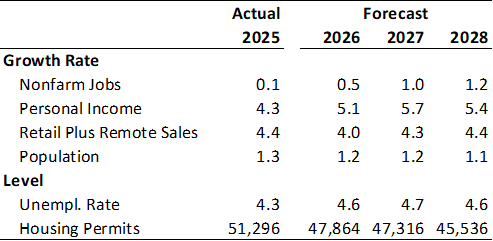
If the U.S. economy continues to grow, the baseline forecast calls for Arizona income and job growth to accelerate modestly next year (Exhibit 2).
The forecast calls for Arizona job growth to rise from 0.1% in 2025 to 0.5% in 2026 and 1.0% in 2027. Even so, state job growth is expected to be very slow compared to historical standards, including the slow recovery from the Great Recession. The state unemployment rate is forecast to tick up in 2026 and then stabilize at a relatively low level.
Over the next ten years, the state is projected to add a total of 386,200 jobs, which translates into an average annual growth rate of 1.1% per year. That is one-half of the annual average growth rate during the prior 10-year period (2.2%). Private education and health services; professional and business services; leisure and hospitality; financial activities; and trade, transportation, and utilities lead gains during the next decade and account for 88.7% of total state job growth.
Income growth also accelerates modestly, reflecting rising wage growth due to tight labor market conditions caused by reduced international immigration and mass deportations.
Solid income gains leave growth in retail plus remote sales fairly steady in coming years, in a range between 4.0% and 4.4%.
Population growth begins to decelerate next year, falling from 1.3% in 2025 to 1.2% in 2026, reflecting headwinds from falling natural increase and steady net migration.
As population growth loses steam, housing permits decline steadily through the forecast.
Exhibit 2: Arizona Short-Run Outlook
The Phoenix and Tucson metropolitan areas follow the state pattern of slightly increased, but slow growth, during the forecast.
Phoenix MSA job growth is projected to rise from 0.3% in 2025 to 0.7% in 2026 and 1.2% in 2027. Job growth in the Tucson MSA is forecast to rise from 0.1% in 2025 to 0.2% in 2026 and 0.4% in 2027.
Population growth for both Phoenix and Tucson gradually decelerates during the forecast, as declining natural increase weighs on gains. The forecast calls for Phoenix population growth to remain steady, at 1.5% in 2026, but then slow to 1.4% in 2027 and 2028. Tucson population growth is forecast to decelerate from 0.7% in 2025 to 0.6% in 2026 and 0.5% in 2027.
VIEW MOST RECENT FORECAST DATA FOR ARIZONA, PHOENIX, AND TUCSON
If your business or organization requires more timely and in-depth forecast data and analysis, find out about the benefits of joining EBRC’s Forecasting Project and email EBRC research professor George Hammond at ghammond@arizona.edu.
Copyright 2026 Economic and Business Research Center, The University of Arizona, all rights reserved.